A Region-by-Region Overview
Egypt's archaeological sites span approximately 1,200 kilometres from the Mediterranean coast to the border of Sudan. The most famous sites cluster in two regions: the Nile Delta and Cairo area (including Giza and Saqqara), and the Upper Egyptian Nile corridor from Abydos south through Luxor to Aswan. A third zone — the Western Desert and the oases — contains important sites that receive far fewer visitors but are equally fascinating for their isolation and preservation.
We have organised this guide geographically, moving from north to south as one would travel the Nile. Each site entry includes the name, approximate historical period, current access conditions and a note on what makes it distinctive. For guided visits to any site listed here, see our day tour options.
Giza Plateau — Pyramids, Sphinx and Old Kingdom Tombs
The Giza Plateau is the world's most recognised archaeological landscape. The three principal pyramids — Khufu (c.2560 BCE), Khafre (c.2530 BCE) and Menkaure (c.2510 BCE) — are Old Kingdom royal tombs on a scale that still defies easy comprehension at ground level. The Great Pyramid of Khufu stands 138.5 metres and contains roughly 2.3 million stone blocks. Surrounding the pyramids are the mortuary temples, causeways, the Great Sphinx (carved from a natural limestone outcrop), and hundreds of subsidiary mastaba tombs of nobles and officials.
The site receives approximately 14,000 visitors per day in peak season, which means early arrival (the gates open at 08:00) is essential. Pyramid interior access is ticketed separately and limited daily — book in advance. The Eastern and Western cemeteries contain superbly decorated mastabas that are frequently missed by visitors focused on the pyramids alone.
Saqqara — The First Pyramid and the World's Oldest Texts
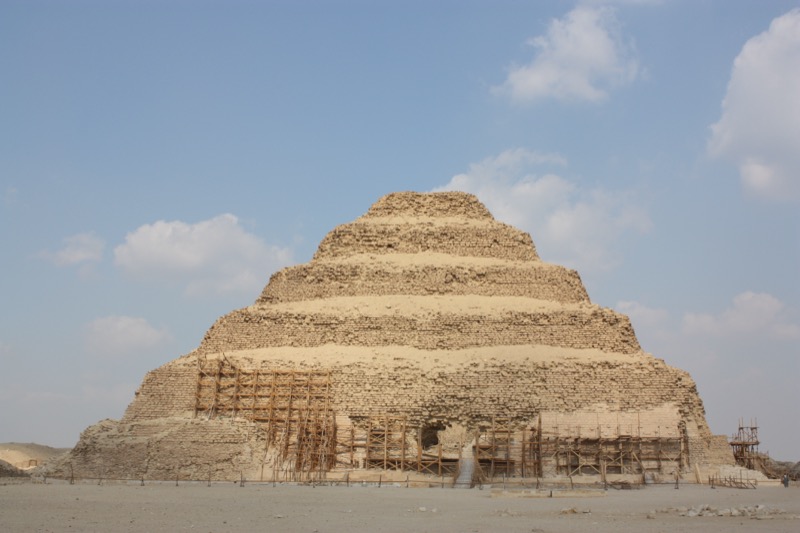
Saqqara served as the necropolis of Memphis, Egypt's first unified capital, from the 1st Dynasty (c.3100 BCE) through the Coptic period. The Step Pyramid of Djoser, designed by Imhotep around 2650 BCE, is the world's oldest large-scale stone monument — a revolutionary structure that transformed Egyptian funerary architecture. Surrounding it is a 15-hectare walled complex of shrines, courts and ceremonial buildings.
Beyond Djoser's complex, Saqqara contains the Pyramid of Unas (5th Dynasty) whose interior walls are covered with the Pyramid Texts — the oldest corpus of religious literature ever found. The New Kingdom animal catacombs — vast underground galleries housing mummified ibises, falcons, bulls and cats dedicated to various deities — are one of ancient Egypt's most extraordinary subterranean spaces. Access to the deeper sections of the catacombs requires a permit that we arrange in advance for Scholar-level bookings.
Memphis (Mit Rahina) — Egypt's Ancient Capital
Memphis was founded at the beginning of the dynastic period as Egypt's first capital and remained one of the country's most important cities for 3,000 years. Today little survives above ground — the city was quarried extensively for building material during the medieval period — but the open-air museum at Mit Rahina preserves two remarkable pieces: a colossal recumbent statue of Ramesses II (approximately 10 metres long, probably carved during his reign in the 13th century BCE) and a large alabaster sphinx of uncertain date. The contrast between these objects' scale and the modest village surrounding them is itself instructive.
Tell el-Amarna (Akhetaten) — The Heretic Capital
Amarna is among the most fascinating sites in Egypt precisely because it was deliberately erased. Built by Akhenaten around 1346 BCE as his new capital dedicated solely to the Aten (the solar disc), it was abandoned within twenty years of his death and systematically dismantled by his successors. What remains — boundary stelae cut into the cliffs, foundation outlines of the great temples, the rock-cut tombs of Akhenaten's officials, and some of the finest relief carving of the New Kingdom — allows archaeologists to study a pharaoh's unique ideological vision in isolation. The site is reached from the Nile town of Mallawi and rewards visitors prepared with significant background knowledge. We include Amarna in specialist itineraries on request.
Abydos — Cult Centre of Osiris
Abydos is one of ancient Egypt's most sacred sites, home to the earliest royal tombs and the great Temple of Seti I. The Seti I temple, built in the 13th century BCE, contains some of the finest painted reliefs in existence — vibrant, well-preserved colour showing the king before the gods in processions and ritual scenes. The adjacent Osireion is a mysterious subterranean structure associated with the burial of Osiris, built on a scale and in a style that sits oddly with the rest of the site. The Kings List at Abydos — a corridor inscription naming seventy-six previous rulers — was a crucial tool in establishing the ancient Egyptian dynastic sequence.
Dendera — Temple of Hathor
The Temple of Hathor at Dendera is one of Egypt's best-preserved ancient temples, built primarily during the Ptolemaic and early Roman periods (1st century BCE to 1st century CE). Because it was buried under desert sand and village buildings until the 19th century, its painted ceilings retain extraordinary colour. The famous Dendera Zodiac — a circular astronomical ceiling relief — is the most famous feature, though the original was removed to the Louvre in 1821 and replaced with a cast. The temple roof offers views over the entire complex and contains the small Osiris chapels with their beautifully detailed reliefs. Dendera is usually combined with Abydos in a single long day from Luxor or a dedicated overnight stay in the area.
Karnak Temple Complex, Luxor
The Karnak complex grew continuously from the Middle Kingdom (c.2000 BCE) through the Ptolemaic period, with each new pharaoh adding pylons, obelisks, chapels and statues to demonstrate piety and power. The main precinct — the Precinct of Amun-Re — is what most visitors see and it alone takes two to three hours to explore properly. The Hypostyle Hall, built under Seti I and Ramesses II, contains 134 columns, the largest of which are 24 metres tall and nearly 10 metres in circumference. The hall was the most sacred processional space in Egypt during the New Kingdom. The Karnak Open Air Museum, within the complex, displays dismantled structures reconstructed from found fragments — including the White Chapel of Sesostris I, one of the finest pieces of Middle Kingdom relief carving known.
Valley of the Kings, West Bank Luxor
Sixty-three tomb shafts have been identified in the Valley of the Kings to date, representing the burial places of pharaohs, queens and senior officials of the New Kingdom (c.1550–1070 BCE). The valley was chosen for the same reason the pyramid shape had once been chosen — its peak is a natural pyramid form, and the remote location was intended to deter robbers. It failed in that purpose almost entirely; only KV62 (Tutankhamun) was found relatively intact, and even that had been entered in antiquity. The painted walls inside the tombs — showing the king's journey through the underworld, guided by Osiris, Re and a cast of protective deities — are among the most sophisticated religious art produced in the ancient world. Our guided programme covers the relevant theology in depth before you enter.
Philae — Temple of Isis
The Temple of Isis at Philae is one of the last ancient Egyptian temples to have been built, primarily during the Ptolemaic and early Roman periods, and one of the last to have been used — a community of Isis priests continued worship there until the 6th century CE. The temple was relocated from its original island to Agilkia Island following the construction of the Aswan High Dam. The relocation preserved the structure but altered the dramatic setting in which water once lapped against the temple's lower courses. An evening sound and light show is available; we consider the morning visit in natural light more rewarding. Boat access from Shellal landing.
Abu Simbel — Temples of Ramesses II and Nefertari
Cut from the sandstone cliff of the Nile's west bank by Ramesses II around 1264 BCE, the two Abu Simbel temples are among the most imposing monuments ever created. The Great Temple's four seated colossi of Ramesses II are each 20 metres tall; the interior sanctuary was aligned so that on two days per year — 22 February and 22 October, believed to correspond to the pharaoh's birthday and coronation — sunlight penetrates 65 metres into the rock to illuminate three of the four sanctuary deities. The Small Temple, dedicated to Nefertari, is unusual in that its facade features a queen at the same scale as the king — a rare acknowledgement of royal wives in monumental architecture. Our Abu Simbel programme departs at 04:30 from Aswan to arrive at dawn. See our day tours page for details.
Access and Permit Conditions
Most Egyptian archaeological sites operate under a tiered access system managed by the Ministry of Tourism and Antiquities. The standard visitor ticket covers a defined area or a set number of tomb entries. Restricted areas — certain tomb interiors, the deeper sections of underground complexes, photographic access to specific objects — require advance permit applications that we submit on behalf of Scholar-level bookings.
It is important to note that access conditions at Egyptian sites change frequently. Areas closed during excavation may reopen; newly discovered areas may be temporarily restricted. Our team monitors these changes continuously and adjusts itineraries accordingly. When a significant new opening occurs — as happened with several Saqqara tombs in 2024 — we update available access arrangements within days and notify relevant bookings.
For detailed guidance on planning a visit to any site listed here, contact us via the contact page or browse our visitor tips for practical preparation advice.